Main menu
You are here
Ham Radio - Fox Hunt Transmitter Keyer
[last updated: 2023-02-08]
ham radio home page
attenuators
-----
- This project uses an Arduino to send periodic messages (initially morse code) to a Baofeng UV-5R mic input.
I will be using 2m, 145.6 MHz, a frequency in the "miscellaneous and experimental" band plan. - Customary freq is 146.565 in California (Del Norte club)
- The first rev is based on a create.arduino project (https://create.arduino.cc/projecthub/nfarrier/auto-keyer-for-radio-fox-h...).
It uses an arduino programmed to activate transmission via the radio's PTT control, and send a message.
The arduino program energizes a relay (replaced with a transistor in my circuit) to close the PTT contacts
(PTT line on Baofeng must be grounded to activate transmit). - What gets transmitted:
- Note: the protocol/syntax of the transmitted message is arbitrary, but must include your call sign.
It should include something identifying it as a transmission from a fox. - send a CW message identifying your ham call sign and text "FOX" to identify the transmission,
- the tone is produced by Arduino and is input to the mic input on the Baofeng.
- a 7-sec or so, 1000 Hz tone,
- wait for a time (with PTT still closed),
- release PTT,
- wait for a time,
- repeat.
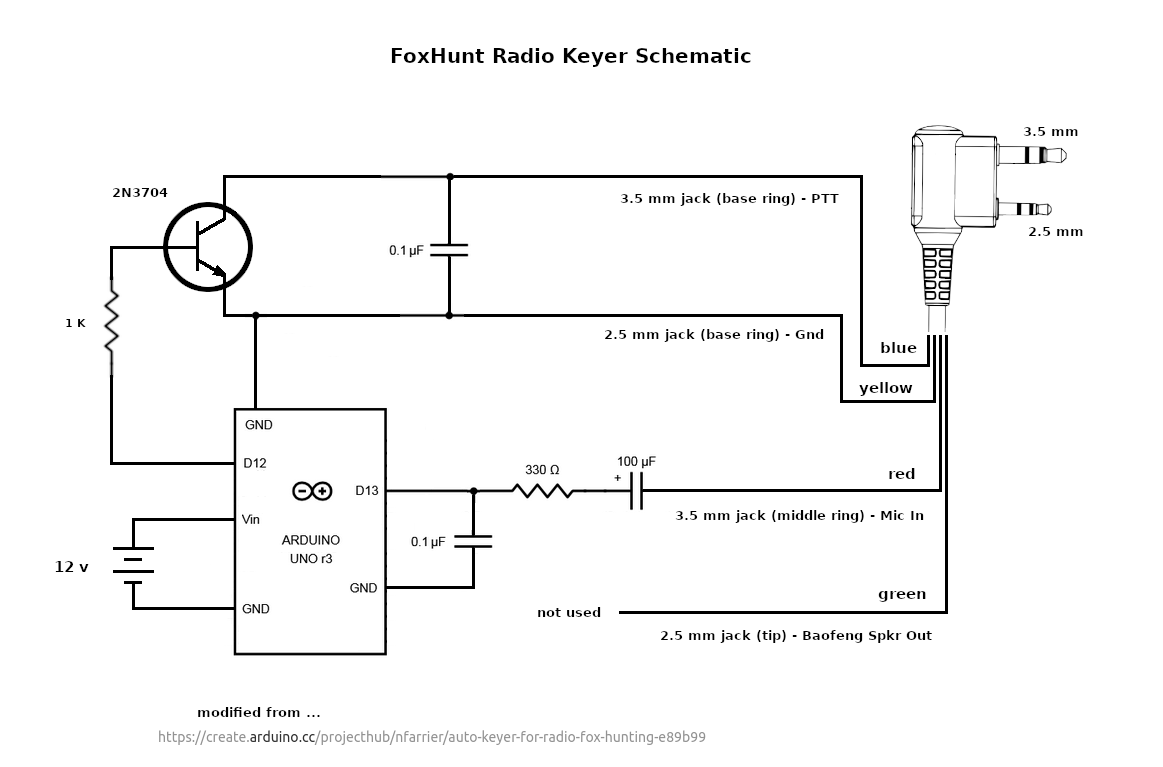
from arduino.cc project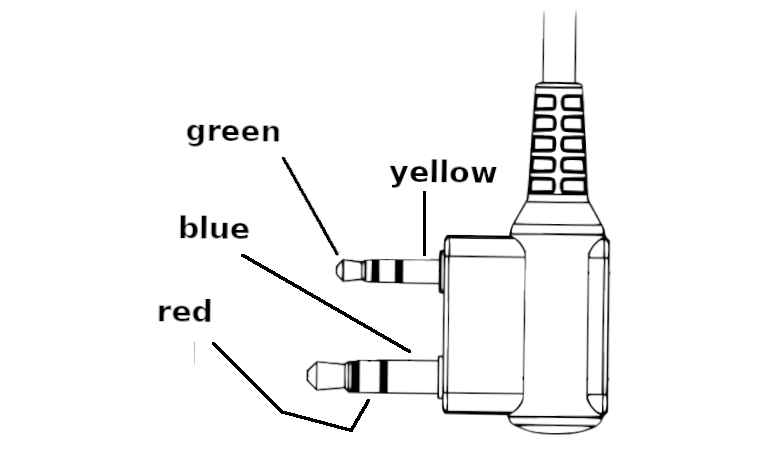
from my earPiece plug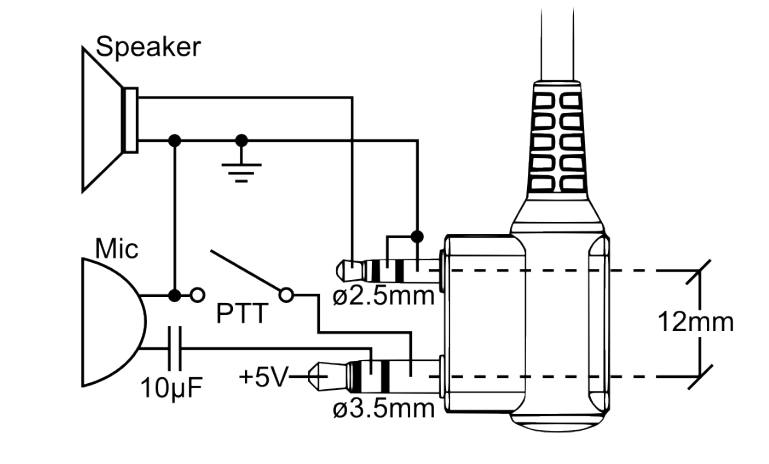
from Operation Manual - Note: the protocol/syntax of the transmitted message is arbitrary, but must include your call sign.
- Hardware: I pulled apart a Baofeng ear piece to get at the wires and map them. OMG they are tiny. Each "wire" (4 total - see diagram above) has maybe 10 strands of thread-like wires, wrapped with smaller threads of probably nylon.
It was a tedious job (under a magnifier/microscope) to separate the nylon to allow twisting together the thread-wires.
Each of them appeared to have a (colored) enamel insulation. After removing the nylon and twisting the wires together, I used high soldering iron heat to melt through the enamel to tin the ends. - The first breadboard circuit, using a Nano r3, worked as designed. Volume/signal-strength at receiving Baofeng was OK, with tone good and clear.
- Next version used a microduino board. Some pinouts were changed from -06 program.
----------------------------------------------------------------
- Links:
- (link to:) Byonics micro-fox transmitters
- (link to:) Amazon 1w VHF transceiver
- (link to:) APRS tracker review
- (link to:) VK3YNG Foxhunting equipment and info links
- (link to:) RBMX146 2m transmitter module for APRS
- (link to:) FoxTTL DIY transmitter
- (link to:) Arduino DTMF generator on github by dilshan
- (link to:) Arduino DTMF generator by LloydM
- (link to:) Arduino DTMF generator by dilshan - project page
- (link to:) The Test Call - debug site
- (link to:) Arduino DTMF generator by dilshan - arduino.cc page
- (link to:) byonics
- (link to:) wcar.ca
- (link to:) Instructables - fox w/ Uno & sound board
- (link to:) arduino.cc project
- (link to:) Hackaday - project using sdr
.
.
.
eof
Powered by Drupal